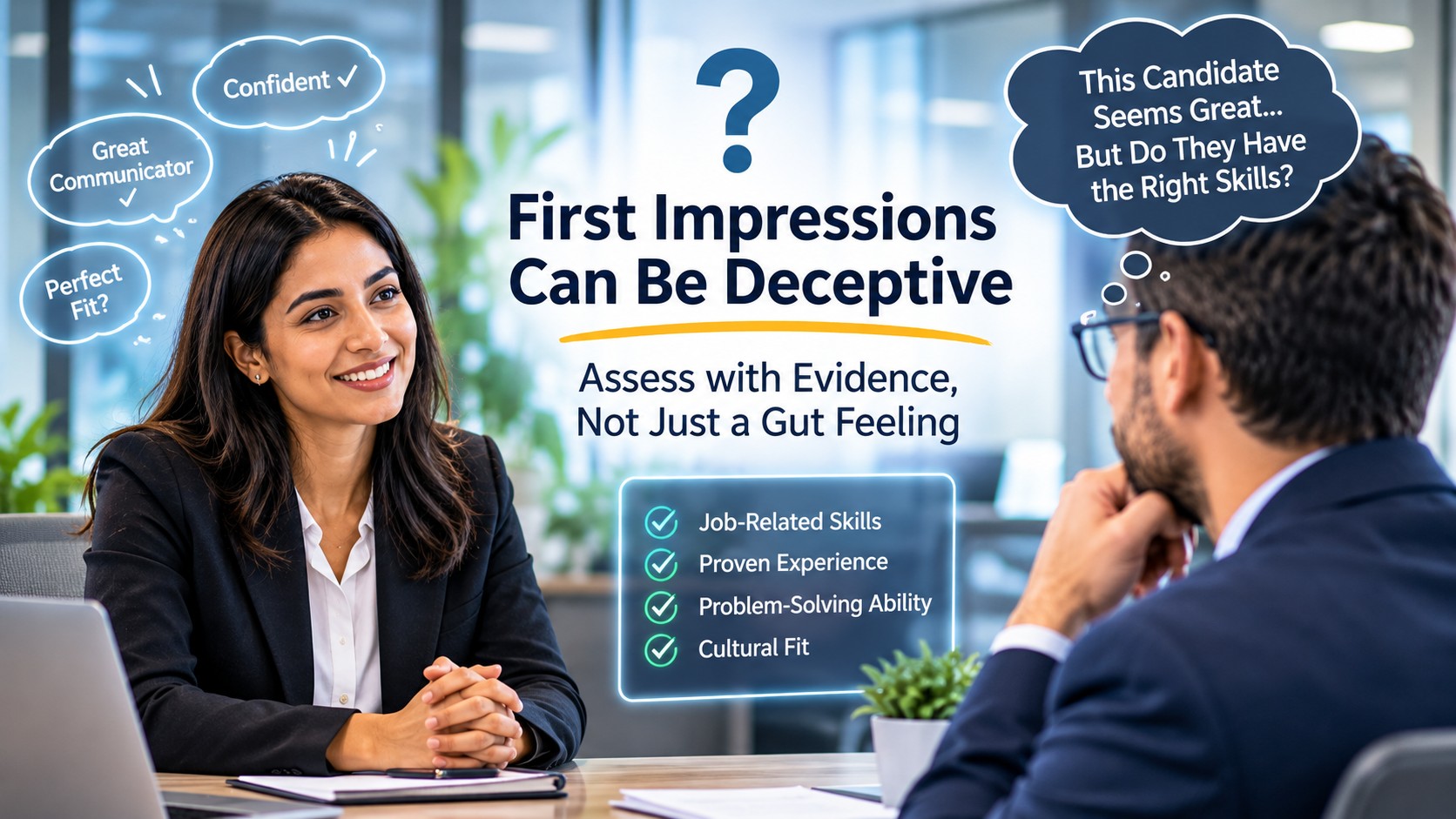
A candidate makes an engaging introduction. The conversation flows easily. Before the interview reaches its first substantive question, the interviewer is already thinking: "This person would be great on our team."
That reaction may be understandable. It is not yet evidence that the candidate can do the job.
Now imagine a second candidate who takes longer to answer, asks for a question to be repeated and seems less comfortable with small talk. Later, their explanation of a difficult project reveals careful reasoning and practical expertise.
These are illustrative scenarios, not findings about particular candidates. They raise a useful question: Are we assessing the capability the role requires, or the experience of having a conversation with someone?
First impressions do not need to be ignored. They need to be tested against job-related evidence.
This article explains common judgment traps and offers a practical way to keep an initial reaction from becoming an unsupported hiring verdict. It does not claim that every interviewer experiences every bias or that any checklist can eliminate bias completely.
1. An Impression Is a Hypothesis, Not a Hiring Decision
An interviewer might notice confidence, hesitation, warmth or an unusual career path. Each observation can prompt a question. Problems arise when it becomes a conclusion without further investigation.
"Explained the project clearly" is an observation about a particular response.
"Will be a strong leader" is a broader inference that needs more evidence.
Keep those categories separate:
- Observation: what the candidate said or did.
- Interpretation: what you think the observation means.
- Missing evidence: what you still need to assess.
For example, a candidate giving a brief answer does not establish that they lack expertise. A focused follow-up might reveal that the original question was unclear.
Equally, an engaging answer does not prove that the candidate personally delivered the result they describe. Ask about their actions, constraints, trade-offs and what they would do differently.
The goal is not to suppress intuition. It is to stop intuition from silently replacing verification.
2. Four Judgment Traps to Watch For
The following concepts provide useful ways to examine interview reasoning. They are not diagnoses of an interviewer or proof that a particular decision is unfair.
The halo effect: one strength becomes every strength
A polished presentation, familiar employer or impressive achievement can shape judgments about unrelated capabilities.
Imagine inferring excellent project execution from a candidate's public-speaking skill. Both might matter, but one does not automatically establish the other.
Ask: "Which separate evidence supports each capability we rated?"
Confirmation bias: the interview becomes a search for agreement
After forming an early opinion, an interviewer may give supportive examples more weight than conflicting ones.
A practical counter-question is: "What evidence would make us reconsider this initial assessment?"
Use that question for a positive impression as well as a negative one. It should not become an excuse to interrogate only candidates the interviewer already doubts.
Affinity bias: familiarity feels like suitability
Shared interests or similar professional backgrounds can make a conversation comfortable. That comfort is not necessarily evidence of role suitability.
Instead of asking whether someone is "like us," ask which work behaviors support effective collaboration.
Can the candidate explain a disagreement, seek relevant input or handle a difficult handoff? Those questions are more actionable than a vague appeal to cultural fit.
Contrast effects: the previous interview changes the comparison
A candidate can seem stronger or weaker because of the conversation immediately before theirs.
Return to the agreed standards rather than using the last person interviewed as the benchmark. A vacancy should be filled against role requirements, not simply by choosing the most impressive person in a particular sequence.
3. Confidence and Competence Are Different Questions
Confidence can be relevant when a job requires a particular communication behavior. But it should be translated into something observable and proportionate to the role.
For example, a customer-facing role might require explaining a technical trade-off to a nontechnical audience. Assess that explanation, rather than relying on how assertively someone introduces themselves.
Avoid assuming that eye contact, accent, rapid answers or small-talk style reveal intelligence, honesty or leadership potential. Those cues can have many explanations and should not substitute for job-related evidence.
Provide clear instructions, reasonable preparation information and appropriate accommodations. Do not treat interview discomfort as a shortcut for assessing someone's ability to perform under every kind of workplace pressure.
OPM's assessment strategy guidance notes that assessment consistency can be affected by factors including anxiety, administration conditions and scoring procedures.
That does not mean every awkward answer should receive a positive rating. It means the conditions and criteria deserve attention before a score is treated as an objective fact.
4. Structure Helps Make the Comparison Visible
The U.S. Office of Personnel Management describes structured interviews as using the same predetermined questions in the same order, with responses evaluated against the same rating scale and standards.
This offers a practical alternative to interviewing by conversational chemistry.
Before meeting candidates:
- Define the important capabilities for the role.
- Decide which capabilities the interview will assess.
- Prepare the core questions and consistent follow-up approach.
- Describe what weak, adequate and strong evidence would look like.
- Agree on how interviewers will record evidence and discuss uncertainty.
A structured process need not be cold. Welcome candidates, explain the format, answer their questions and allow appropriate accommodations while preserving a comparable assessment of the core requirements.
Structure also does not guarantee a good decision. A consistently asked irrelevant question is still irrelevant.
5. Turn "Good Communicator" Into Evidence
Consider this illustrative interview question:
"Tell us about a time you had to explain a delivery trade-off to a stakeholder who initially disagreed."
Useful evidence might include:
- What the disagreement concerned.
- How the candidate understood the other person's priorities.
- Which options they considered.
- How they explained consequences and uncertainty.
- What happened and what they learned.
Compare two possible evaluation notes:
Impression-led: "Very articulate. Seems senior. Would fit well."
Evidence-led: "Explained two delivery options, identified the customer's deadline constraint and described how they documented the agreed compromise. We still need evidence of handling a larger cross-team dependency."
The second note is more useful because someone else can understand the reasoning and the gap.
Do not require every candidate to tell the same kind of polished story. Relevant examples may come from different work, educational or other appropriate contexts, depending on the role.
The objective is evidence of capability, not familiarity with an interview-answer formula.
6. Add Work Evidence Where It Answers a Real Question
Some capabilities are easier to explore through a short task than a conversation alone.
A candidate might review a fictional customer escalation, explain a small code change or prioritize a project scenario.
OPM's work sample guidance emphasizes tasks that mirror the work and cautions that these methods suit competencies expected upon entry. Testing work the organization intends to teach may be inappropriate.
Keep the exercise reasonable, accessible and clearly explained. Tell candidates how it will be assessed and what assistance, including AI tools, is permitted.
Do not ask for unpaid business deliverables or assume a long take-home task is necessarily a stronger assessment.
Work evidence is an additional perspective, not an infallible truth machine. Review its limitations alongside interview evidence.
7. Use an Evidence-First Debrief
A hiring discussion can drift when the first person to speak offers an enthusiastic or dismissive summary.
One practical approach is to ask evaluators to record their initial ratings and supporting observations before the group meets. This is a process suggestion, not a guarantee of independent or unbiased judgment.
During the debrief:
- Discuss one job-related capability at a time.
- Share the evidence supporting each rating.
- Separate missing evidence from demonstrated weakness.
- Investigate differences rather than immediately averaging them.
- Identify any assumptions that came from an early impression.
- Record unresolved questions and who will resolve them.
Replace "I just didn't connect with them" with a more precise question: "Was there a relevant work behavior we did not observe, and did the assessment give them a fair opportunity to demonstrate it?"
Sometimes evidence will support the original impression. Sometimes it will challenge it. Either way, the final explanation should be stronger than a feeling.
8. Copy This First-Impression Check
Use these questions before making a final recommendation. This is an editorial discussion aid, not a validated psychological test or compliance certification.
Before the interview
- Which essential capabilities are we assessing?
- Are the questions and standards relevant to the actual work?
- Have candidates received clear instructions and a route to request accommodations?
After the interview
- What was my first impression?
- Which observations support it, and which challenge it?
- Have I confused confidence, familiarity or presentation style with another capability?
- Did I record evidence separately from interpretation?
- Did the candidate have a comparable opportunity to demonstrate the requirement?
Before the decision
- Can I explain the recommendation using job-related evidence?
- Are we comparing candidates with agreed standards rather than with each other alone?
- Have we investigated conflicting evidence and acknowledged uncertainty?
- What should be clarified before proceeding?
An unanswered question is a reason to investigate appropriately, not an automatic rejection or a demand for endless extra interviews.
9. AI Should Not Automate a First Impression
AI can help organize interview notes or summarize information against a defined rubric. It can also make a weak inference sound confident.
Compare any summary with its source. Ask whether it preserves uncertainty and distinguishes a candidate's demonstrated actions from an evaluator's opinion.
Do not treat inferred personality, emotional state or credibility from appearance, voice or mannerisms as a substitute for evidence of the work. Automated outputs require scrutiny, not a lower standard.
Human reviewers remain accountable for hiring decisions. Protect candidate information and evaluate the process for unfair barriers.
For a broader view, read why more hiring data does not automatically produce better decisions and our guide to reducing hiring bias.
A Better Hiring Question: "What Have We Actually Learned?"
First impressions are part of human interaction. The aim is not to pretend they disappear.
The aim is to build a process in which an initial impression cannot become a verdict without a clear, job-related explanation.
Start with one role. Review its interview questions, rewrite one vague rating into observable evidence and ask the team to distinguish what it saw from what it inferred.
A good interview does more than help a team feel confident about a candidate. It helps the team explain why that confidence is justified.
To understand the wider consequences of weak selection, explore the hidden cost of a bad hire.
Want to assess how TalentMeta AI supports resume screening, AI-conducted interviews and job-description-based scoring? Schedule a demonstration and evaluate the workflow against your own role requirements.
Sources and Further Reading
- U.S. Office of Personnel Management: Structured Interviews
- U.S. Office of Personnel Management: Designing an Assessment Strategy
- U.S. Office of Personnel Management: Work Samples and Simulations
Published by TalentMeta AI. This article offers general hiring-process guidance, not a psychological diagnosis or legal advice.